Jamie Raskin Is Not Afraid to Impeach Trump Again
杰米·拉斯金不怕再次弹劾特朗普
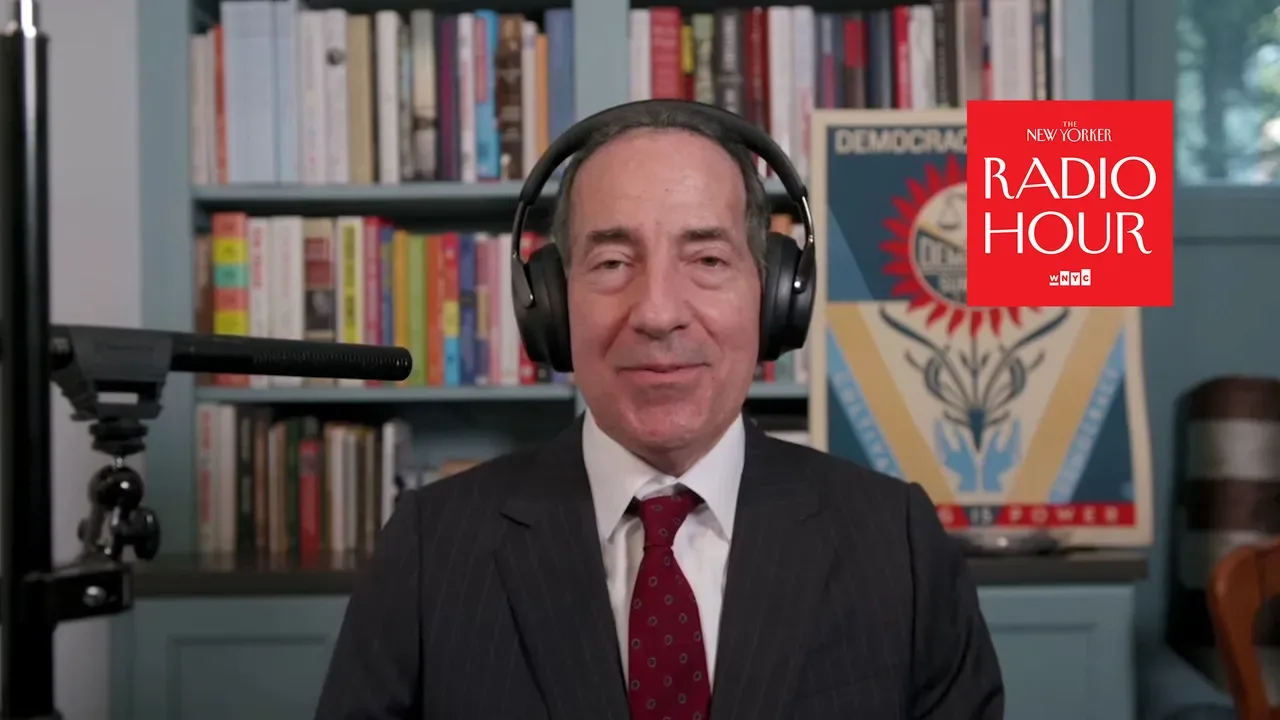
The Maryland congressman talks about how the Democratic Party is fighting the President’s “gangster state.”
马里兰州众议员拉斯金在中期选举前接受访谈,认为共和党长期通过选区划分操纵选举,民主党即使赢得众议院也需在弹劾与民生议程之间权衡。他强调弹劾是宪法工具箱中的工具而非禁忌,但当前优先事项是恢复医保等公共政策。
这是一篇长篇访谈,适合练习在问答往复中追踪说话人立场:拉斯金对弹劾的态度从“不怕”到“暂不推进”,需要读者分辨哪些是原则、哪些是策略。文中多处用具体数字(2.2亿美元、每小时超百万)和州级选举结果作论据,可练数据定位与因果推断;他对共和党、对同党参议员的评价也提供了作者态度的辨析材料。
Listen and subscribe: Apple | Spotify | Wherever You Listen
Sign up for our daily newsletter to get the best of The New Yorker in your inbox.
Serene predictions are a mug’s game, foolish in the extreme, whether they are based on polls or magical thinking. Nevertheless, there is an impending sense among many that the bare-minimum result for the coming midterm elections will be a reassertion of power by the Democratic Party in the House of Representatives. The Senate, the pollsters and the conjurers tell us, is also very much within reach. From Anchorage to Amarillo to Bangor, we shall see.
What then? President Trump will remain President Trump, but how diminished will he be? Will the Democrats set out to conduct investigations into his behavior? Will there be another attempt to impeach him? Jamie Raskin, a Democrat from Maryland’s Eighth Congressional District, was a pivotal figure in the hearings on the January 6th insurrection, and he has been a clarion anti-Trump voice as the ranking member of the House Judiciary Committee.
A former professor of constitutional law who served as lead prosecutor in Trump’s second impeachment trial, Raskin has been a persistent critic of the President’s assaults on the rule of law and his financial dealings, particularly in the second term. His father, Marcus Raskin, was an aide to John F. Kennedy and a progressive activist who co-founded the Institute for Policy Studies, in Washington, D.C. Raskin joined me on The New Yorker Radio Hour to survey the scene ahead of the midterms. We discussed his views on Republicans’ electoral manipulations, where impeachment stands on the list of Democrats’ priorities, the purging of character and critical thinking from Trump’s ranks, and how Trump himself is bringing down the ticket in the Deep South. Our conversation has been edited for length and clarity.
How high is your level of confidence that this will be a fair ballot, that there will be an accurate count, and that the President of the United States, who has a habit of contesting every election, particularly the ones he’s lost—that we won’t be hearing from him on that score after the election?
It’s very clear that Donald Trump knows only two kinds of elections: the ones that he wins and the ones that are “stolen” from him. He thinks in terms of fraud. Everything is a quid-pro-quo transaction for him. And the country is conditioned and ready for that.
In terms of your other questions, let’s start with whether or not it’s a fair ballot, as you say. So much of the Machiavellian manipulation of our elections takes place long before Election Day. Take North Carolina, where I’ve been several times over the course of the campaign. The Democrats have won the governorship. The Democrats have won the attorney-general position. The Democrats are about to win, in a very resounding way, the U.S. Senate position, with Roy Cooper. So, when you look at what’s happening statewide, the Democrats are dominant. But then when you look at the U.S. House delegation, North Carolina’s congressional delegation, that’s ten Republicans and four Democrats.
That’s kind of strange, right? The Democrats are clearly a majority in the state, and yet the Republicans dominate the congressional delegation. Why is that? It’s very simple. It’s because the Republicans have been gerrymandering themselves into power in the state legislature for decades, and, by doing that, they are able to gerrymander the U.S. House delegation as well.
So when you say, “Will it be a fair ballot?” No, it’s definitely not a fair ballot. The Republicans swear by gerrymandering. The Democrats have tried—in the Democracy for All Amendment, in the For the People Act, and in the Fair Representation Act—multiple times to mandate independent, nonpartisan redistricting commissions in every state in the Union. Every Democrat has voted for it, and every Republican opposes it.
And then Trump created this mid-decade, extreme gerrymander in Texas, to squeeze out five more districts. It might backfire on him; nonetheless, it’s certainly worked in some other states, and they’re going to make it work more in 2028. So, if you just start with the gerrymandering—and don’t even get to the other forms of voter suppression that are taking place—no, it has not been fair balloting. Nonetheless, we accept the rules as they are, and we are fighting to win within those rules.
Let’s say Democrats win, at a minimum, the House of Representatives. What maneuver, what form of rhetoric or action, do you fear the most, and what seems the most likely to come from the White House?
Well, the most dread prospect is that Democrats will win U.S. House seats, but the various election officials in charge will somehow try not to grant the certificates of election, requiring everybody to go to court.
Where are Democrats most vulnerable on that score?
Texas is one place where the ground is totally shifting in a pro-Democratic direction. Those five gerrymandered seats that Donald Trump wanted to squeeze out—certainly we’re going to win two or three of them, and we could win four or five. And so there will be so much frustration and embarrassment on the side of the White House that they may try to create some kind of fraudulent pretext for attempting to block them. So that’s the kind of thing that we’re ready for.
We remember when Donald Trump called up Georgia’s secretary of state, Brad Raffensperger, and said, “Just find me eleven thousand seven hundred and eighty votes.” That was not Donald Trump trying to stop election fraud. That was Donald Trump trying to commit election fraud. He was caught red-handed, and the whole country saw it. We know that they have been trying to replace the Brad Raffenspergers of the world in red states with people who will simply do Donald Trump’s bidding. And so I suppose that that would be my biggest fear.
But I don’t want that to overshadow the great hope I have that we are going to see a massive repudiation of the authoritarianism, the war, the illegal tariffs, and the corruption that have descended upon our government.
You are the ranking member of the House Judiciary Committee, and you would have a lot of sway on impeachment proceedings—should that ever happen. If the Democrats take the House, do you think that impeachment proceedings are far off for Donald Trump?
I’ve got a lot of thoughts and ideas about this. First of all, the Democratic caucus is not afraid to impeach. We impeached Donald Trump twice. He has fifty per cent of all the Presidential impeachments in American history. We understand that it’s a political device that’s been put into the Constitution by the Framers, and it’s been put into the political branches. They literally debated whether or not the trial for high crimes and misdemeanors should take place in the Supreme Court, and they decided, No, it belongs in the political branches.
So what does that mean? When Democrats say, “Well, should we start off impeaching Donald Trump for his palpable transgressions against the Constitution, or should we start off by getting everybody their Medicaid back, and their A.C.A. tax credits back, and getting everybody that we can their health care?”—that’s not an illegitimate question to pose. That’s precisely the question the Framers wanted us to pose, because impeachment is a political instrument reposed in the political body.
So we have to consider it in the full context of the public-policy agenda. And we’ve got to meet the needs and the agenda of the public very quickly, for millions of people. For example, the destruction of SNAP benefits—we’ve got to get those people back on SNAP benefits. So—
But, Congressman, if I may, I think what I’m reading here, then, is someone who at once believes in his heart and in his mind that a potential impeachment, technically and legally, could be there, but who senses the greater politics and desires of the public to move on with it, and do things that affect their pocketbook. And senses their greater sense of urgency, perhaps with it in mind that two attempts didn’t work the first time—it didn’t go all the way. Is that fair?
That’s all fair, but, when you use the phrase “move on with it,” it makes it sound like the public doesn’t care about constitutional corruption and transgression; the public cares deeply—
Not that it doesn’t care but that it’s a matter of priority.
Well, that’s absolutely right, and the point I’m making about the history, the Framers, and the creation of the impeachment power is that that’s precisely the calculation the Framers wanted us to be engaged in. We’re not afraid of impeachment, and we’re not even afraid of a trial in the Senate—despite the fact that Donald Trump has only tightened his political stranglehold over the Republican Party. Liz Cheney is gone. Adam Kinzinger is gone. Mitt Romney is gone. He got rid of Senator [Bill] Cassidy. So we know he’s exercising even tighter control now.
And the calculation that we’ve been discussing about Donald Trump might not be the same calculation for Robert F. Kennedy, Jr. It might not be the same calculation for Pete Hegseth. So we believe that impeachment is very much a tool in the constitutional toolbox for Presidents or other public officials who behave like kings, think that they can usurp the powers of Congress, trample the rights and the liberties of the people, and engage in high crimes and misdemeanors against the state. And all of these are live propositions.
But our hands are full right now with a whole bunch of different things. We’ve got to meet the needs of the public. We’ve got to get social progress moving again the best that we can. And then we have to expose and counter all the corruption.
Congressman, we just recently had Sarah Longwell, the publisher of The Bulwark, on the show, and she was interviewed by our writer Evan Osnos. I just want you to listen to a moment of their conversation.
LONGWELL: Some people I respect very much believe that they should pursue impeachment. I do not think that they should pursue impeachment.
OSNOS: Why?
LONGWELL: Because, if there’s one thing that I have seen out of voters during the Trump years, it is that, when Democrats do impeachment, the rally-around-Trump effect is so potent, right? Now they’ve got somebody to fight against. Right now, Republicans are mad at Trump. If I were the Democrats, instead of impeaching Trump the man, I’d go after the tariffs. Go after the war. Go after ICE. Do not do anything that raises his approval ratings. Like, keep going on offense and sinking him lower. Impeachment won’t do that. There are lots of good things that will.
OSNOS: Focus on the issues that brung you to the dance, in this case.
LONGWELL: Yeah.
It sounds to me like your political instinct is to agree with Sarah Longwell in the long run.
Look, every political moment is different and presents a whole constellation of different factors that need to be considered. Obviously, the Democrats in the House of Representatives are not currently pushing an impeachment drive against Donald Trump. It’s not happening, so that is in implicit agreement with what she’s saying. We’re trying to stop this illegal, unconstitutional, catastrophic war, and the only place I would differ with Sarah Longwell—who does such great work—is that this is not a judgment that needs to be made for all time. This is a judgment that needs to be made provisionally for where we are now. It is a tool in the toolbox, just like censure is there, just like the impeachment of Cabinet officials is there, all these things. So let’s not make a fetish out of impeachment. Let’s not make a taboo out of impeachment. We understand it’s not a panacea, but it is an essential tool in the constitutional toolbox that’s always there, and we would never give it away.
Let’s say there’s a blue wave and it’s considerable. Is it possible that, after these midterms, there’s a kind of behavioral change in Congress among the Republicans?
I doubt it. I no longer spend any time forecasting when the Republicans will wake up, for a very specific reason: the critically thinking Republicans, at least the ones in public office, have been purged wherever they can purge them. Donald Trump would much rather have a Democratic senator from Texas—which, knock on wood, fingers crossed, we’re going to get with James Talarico—than a Republican senator from Texas who has critical-thinking distance from Donald Trump and his cult of authoritarian personality.
And that’s true all over the country. I mean, he runs this thing like it’s his little Mob family. So will there be some insurgent breakaway faction within the Republican Party that’s willing to try to take on Donald Trump? Maybe. I tend to doubt it, and I think the best of them—people like Adam Kinzinger—are looking for another path forward, whether that’s being an Independent, whether it’s becoming a Democrat, or doing something else.
But I just don’t see that happening. It’s a question of character, and the people who are still in there have demonstrated that they don’t have any.
So it remains the party of Trump, and Trumpism, no matter what.
Well, yes, as long as Trump is around, and as long as the Trump family can maintain a monopoly on the revenues that come into the Republican Party. Remember, this has been a money-making operation from Day One. I mean, you’ve got to look at this thing like “The Sopranos.” This is a family business. They’ve been making billions of dollars. In his first year in office this term, Trump openly declared 2.2 billion dollars that he made on the side. That’s more than a million dollars an hour. His official Presidential salary is four hundred thousand dollars. That means that he made double his entire Presidential salary in one hour.
And so, of course, the rest of his time, he’s focussed on the corruption. That’s where the money is. Why have they not done even any of the stuff that he says in passing, frivolously, that he’s going to do? Like, “Oh, yeah, we’re gonna have the best health-care system in the world, and we’re gonna have the most beautiful environment in the world.” He doesn’t do any of that stuff. He doesn’t care about public policy. Those guys are in a money-making business. They’ve turned the executive branch of the government—under their unitary-executive theory—into a money-making operation for what’s essentially a Mob boss, and they’ve given us a gangster state.
One of the biggest differences between just winning the House and winning the House and the Senate is that, if Democrats win the Senate, any Supreme Court nomination—say, a successor to Samuel Alito, should he decide to step down—can be blocked. Tell me about the effect of the blue wave, if that’s what’s going to happen, on the Supreme Court.
Well, the critical power that the U.S. Senate wields is the power of advice and consent. Trump, in his inimitable way, has tried to get around that by appointing acting people and appointing people to jobs that don’t require Senate confirmation, and so on, and then basically outsourcing large parts of the government. If you look at the role of Jared Kushner this time, he is not officially in the government. He is a billion-dollar bagman, essentially. They’ve basically set the government up around a series of political slush funds—and they have private slush funds on the side which are all for money-making.
But I’d say that the Supreme Court is a critical actor in the degradation of our government, and it is absolutely essential that we have a Democratic majority there—by which I mean at least fifty-two, because Senator [John] Fetterman cannot be trusted for these purposes.
Drill down on that a little bit more. Where can you trust and not trust Senator Fetterman, from Pennsylvania?
Look, at this point, we need to get to fifty-two. We can’t leave these things to chance. We saw what happened with Senator [Joe] Manchin.
Tell me about Senator Fetterman, for the moment.
You’d have to ask my Senate colleagues, who know him a lot better than I do. I know a lot of young people who worked on his first campaign—and I’ve campaigned a lot in Pennsylvania—and everybody tells me that they loved him when he was first out there. But it’s over now. It’s completely over. They don’t trust him, and they view him like Manchin or like Kyrsten Sinema, somebody who is just as likely—
So this is an ideological switch, and not a matter of mental health?
Again, that goes beyond my knowledge of the situation, so I can’t say. There’s a lot of speculation out there, but, in the final analysis, I’m not sure it makes any difference exactly why he’s arrived at this point. But we need somebody who’s going to understand that they’ve turned this into a right-wing MAGA corporate Court.
One of the most memorable episodes of the late Obama years, of course, was the attempt to nominate and put forward Merrick Garland to the Supreme Court, which was blocked by Senator [Mitch] McConnell. “It was a political season,” “we couldn’t possibly do this”—and of course it dragged on forever, and, of course, Trump won, and they got their Republican. Is the Democratic Party willing to play hardball if it comes to a similar situation?
Well, yes, this Court is an illegitimate Court on a number of levels. It has been composed illegitimately, by denying President Obama and the Senate the opportunity to advise and consent, and presumably to confirm one of the best people ever nominated to the Supreme Court, and then barrelling through—Amy Coney Barrett went through eight days before the Presidential election—
With respect, I get that. What I’m asking—
Not everybody gets that! David, I’m about to answer your question. Not everybody gets that point. And the Republicans don’t want anybody to remember it. Most people’s political memory now is, like, fifteen minutes, because of the barrage of authoritarian attacks we’re under here. So people need to understand that.
They could put up the two most brilliant Scalia clones in the world, and those people should not be put on the Court, because two seats have already been stolen from us. Now, I’m saying that from the House side. I’m not on the Senate side, and I’m not speaking for anybody over there. But I’m willing to tell you that, from my perspective on this, they have already cheated us out of a fair Supreme Court.
But if it comes to it, if Alito were to retire in ten months, would the Democrats block a Republican Trump nominee the way it was done to them?
I mean, ask me about me. Would I? Absolutely. You’re damn right I would! But, if you’re asking about the Senate, you’ve got to talk to someone on the Senate side. I literally have not had that conversation with my presumed counterpart on the Senate side, Senator [Sheldon] Whitehouse, or any of the other senators. But, look, at this point, they want—like Donald Trump, because they follow him in everything—the Supreme Court to be a loyal rubber stamp for whatever he wants. That Presidential-immunity decision is an outrageous departure from American jurisprudence. These people call themselves originalists—where do you see that in the Federalist Papers? Where do you see it in the Constitutional Convention? Where do you see it in the ratifying conventions? Nowhere! It’s not in the Constitution. They pulled it out of a hat. The stork brought it. That’s the way they’re doing jurisprudence. So, you ask, are we going to play tough? I hope so. I certainly hope so.
In the line of outrages, what about your colleague Ilhan Omar, who recently had her home searched by federal officers ahead of her reëlection? Do you think the Democratic Party is doing enough to protect her? President Obama spoke out in her defense recently, but I haven’t heard a lot from Chuck Schumer and other leaders of the Democratic Party.
I sent a statement, a tweet, and a letter that day. The Party is going to be totally against this completely vindictive and political prosecution and persecution, the way we were against the political prosecution and persecution of James Comey, Letitia James, Adam Schiff, Mark Kelly, Maggie Goodlander. We’re standing together. This is a different Democratic Party, David. We’re not rolling over for anybody. And I believe this is just a phony, easy media frame to say, “Are you against the high prices, or are you against corruption?” Why do we have to choose? It’s the same thing! That’s what I hear everywhere I go now.
And half the people are saying, “The Democrats are just going to let them all go and let them off the hook on corruption.” The other half are saying, “They should let them all go. They should just focus on restoring Medicaid and A.C.A. tax credits,” as if we cannot do both. We can do both, and we will do both.
What do you think Donald Trump’s reaction to a blue wave would be? What kind of President would he be in the last two years?
We’ll get a mixture, at the beginning, of denial and blame. He will deny that the results are actually the results. But then, more likely, he will shift into a blame mode—that all of the Republicans sucked, and they didn’t do exactly what he told them to do. They will blame him for being Trump, and there’s no doubt that he is the albatross and the dead weight on the ticket. But they’re sending him to places like Mississippi and Alabama right now, in the hope that they’ll win there. Then he’ll be able to say, “Well, wherever I went, we won. In the other places we lost.”
Actually, what he’s doing is bringing down the ticket in both Alabama and Mississippi. He’s bringing down the ticket in some of the reddest parts of America right now. So we say, “Yes, keep him on the road as long as possible.” Keep throwing more of those rallies, because the whole country’s rolling their eyes.
I want to ask you how you see the rise in the legitimacy and reputation of socialism among so many voters on the Democratic side of things. How do you feel about it personally, and what accounts for it?
Well, first of all, when the MAGA people try to use socialism as an epithet, it doesn’t work politically, because so many of the young people now call themselves socialists. And socialism, in that conversation, is really about social democracy or just taking concern in the well-being of the people. I think that’s the way that it’s being used. It’s not about socialization of the means of production and the dictatorship of the proletariat—
It’s about the plunging prestige of capitalism in its present form, I think, too.
Yeah. So that doesn’t hurt us. I don’t know that, analytically, it provides any real insight into our condition that we wouldn’t already have. I mean, the fact of the matter is, marriage equality—same-sex marriage was totally taboo and verboten for the Democrats for a long time; even President Obama had opposed it, and Clinton, of course, had opposed it—has become an organizing principle for us, and I think that’s where we’re going to be on health care. Guaranteed health care for all Americans—whether you call it Medicare for All or National Health Care or something else—I believe that we are on the precipice of that. I think that the prospective election of Abdul El-Sayed, in Michigan, has a lot to do with that, because he’s a doctor and a public-health specialist. I think that people identify him with the coming of a national health care. People might call that socialist or not. It’s not going to make any difference. Just like I think saying we need a socialist system is not going to really help us, analytically, in terms of getting through it.
Now, when Donald Trump calls us communists, that’s where I get my back up—because the only communists left on earth today are Donald Trump’s best friends and his role models. He literally sends love letters to Kim Jong Un, the communist dictator of North Korea, and talks about how perfect he is, and right out of central casting. He makes the same speeches about President Xi, of the Chinese Communist Party. And, of course, he takes orders from Vladimir Putin, who was the head of the F.S.B. So, if he’s talking about communists, he should take that filthy epithet back with him, and hold it up, and look in the mirror, because that’s who his best friends are.
We are the party of freedom and democracy, and we are fighting against the authoritarians and the totalitarians of every stripe. That’s why the people of Ukraine would be nowhere without the support of the Democrats in Congress. We are totally behind them. There are, to be fair, some Republicans sticking with us, but Donald Trump is clearly on the side of Vladimir Putin. He just said he’s not going to impose the sanctions that Congress just overwhelmingly voted for. He wants to do this very dirty diesel deal with Russia so that he’s putting billions of dollars into the Russian war machine, as they crush civilians and blow up apartment buildings and civilian centers in Ukraine. That’s where Donald Trump is now. He’s totally in the camp of Vladimir Putin. So I would say that strong democracy has got to be the governing passion and impulse of the Democratic Party.
Congressman, it’s axiomatic that, within days or weeks, maybe months, after Election Day, you’re going to start to see assemble—like horses at a horse race—a lot of Democrats to run for President. One of them might well be one of your colleagues in the House, Alexandria Ocasio-Cortez. Do you think she’s planning to run? And, if she did, would she be someone for you to support?
Well, I love A.O.C. I consider her someone who has grown immeasurably in office, and she is becoming a truly great political leader. I tend to doubt that she’s going to run for President, because she’s so young, and I very much see her running for the U.S. Senate. I mean, she has another twenty or thirty years to run for President. But maybe she’ll decide she wants to do it now. I don’t know, and I’ve talked to her about the subject.
Congressman, you have Hakeem Jeffries in the House as your leader. Recently, he met with Jared Kushner over the summer, extending some sort of olive branch. Do you approve of that?
The truth is, I’ve not talked to Hakeem about this. I don’t know what the circumstances of that meeting were. I did read that the overture came from the Republican side. But, look, I’m investigating Jared Kushner for his outrageous and egregious conflicts of interest. I mean, he cannot be representing U.S. foreign policy and being our ambassador for peace—or whatever they’re calling him—in the Middle East while he’s on the payroll of the Qataris—
I understand that, but why is Hakeem Jeffries meeting with him in friendly circumstances?
I do not know why he did. I would be very interested to know, but I’m not going to denounce him or criticize him without having had that conversation. Remember, we were not back in Washington for very long before the Republicans sent us home, so that was several crises ago, what you’re referring to.
Fair enough. You just mentioned that A.O.C. is more likely, in your view, to run for Senate than for President.
Yes.
That would leave Chuck Schumer vulnerable, or possibly retiring. What do you think the immediate future—the near future—is for Chuck Schumer?
I think we’re going through a magnificent generational change in the Democratic Party. We’ve got some of the best candidates out on the trail right now that I’ve ever seen. I think that everybody in public office has got to ask themselves whether they’ve made their contribution, they’ve made their mark, and whether it’s time for a new generation to go forward. That’s a profoundly difficult process. It’s a personal process. It’s emotional, it’s psychological, it’s political, it’s sociological. There’s a lot going on there—
Do you think Chuck Schumer’s time has come?
I’m not a New York politician. You’ve got to talk to the New York politicians. I’m also not a senator. You’ve got to talk to the senators. It’s not my call. But I do think that—for everybody who reaches what would be the normal retirement age for most people in America, and who can afford to retire—they should be asking themselves the question of whether all of the experience and expertise they’ve gained outweigh what it means to have a new generation of political leaders coming into office. I think that’s a very difficult question for everybody, and it’s difficult for the junior people, too. ♦
重点词汇
(52)
来源:The New Yorker · newyorker.com